Hire Software Developers or Buy Predictable Delivery? How to Choose

1. What “hire software developers” often really decides
Many teams start from hire software developers posts, recruiters, or a leadership line like “we need headcount”—but the real fork is often full-time roles vs buying predictable engineering capacity (flat monthly, sprints, or a professional team with clear boundaries). Each door carries different risk: org, hiring cycle, culture on one side; scope, acceptance, commercial terms on the other. Mixing that with “whoever is cheapest” tends to grow hidden engineering tax.
This article does not replace HC planning or job descriptions; it offers a short decision lens for conversations with finance and product. For how tax differs across self-build, outsource, and pro team, see Build In-House vs Outsource vs Pro Team.
2. When hire (FTE) tends to win
The more of these are true, the more full-time often pays off:
- Core product and stack must live in org memory for years—security, compliance, domain model inside your boundary.
- You already have (or will soon have) stable engineering management and review cadence—otherwise new hires still land in drift and rework; baseline flow in The Full AI Project Flow.
- Budget is headcount-shaped—CFO wants FTE and annual people cost, not another project invoice.
- You accept hiring-cycle and probation risk—often measured in quarters.
Hire is not only “expensive or cheap” but whether the org can absorb the person; failure modes overlap with 5 Pitfalls When Using AI for Projects. If onboarding slows because tool roles are fuzzy, cross-check Multi-tool Collaboration: How to Make Claude, v0, and Cursor Add Up to More.
Note: if critical roles stay open forever, external peaks help—but if core capability is always rented, you still pay a time tax on learning and iteration.
3. When buying predictable capacity tends to win
The more of these are true, procuring delivery capacity (not ad-hoc gigs) often fits better:
- Demand spikes are clear but you do not want extra FTE for a trough 6–12 months later—big releases, migrations, event tech.
- You want sprint-visible output with clear boundaries, not building AI collaboration norms from zero—see Why Flat Monthly Fee Engineering Fits Growing Teams.
- You lack someone who can own delivery today but the business cannot wait for hiring to close—bridge with external capacity, with scope and exit in writing.
- Hype increases delivery pressure while hiring lags—see From Labubu to the Next Hit: Delivery and Cost Are the Bottleneck.
“Buying capacity” hinges on predictability: low day-rate work without boundaries can still tax more than clearer engagement—same logic as the outsource section in the tax comparison article.
For startups without a mature software development team, buying a bounded external lane with embedded methodology often ships a first shippable line faster than rushing to fill every seat.
4. Hybrid: buy then hire, or parallel
A common pattern: external team ships a bounded slice or foundation while you hire core roles—or parallel core in-house and experimental tracks outsourced. Hybrids fail when ownership is fuzzy: who owns requirements change, on-call, repos, and docs—spell it in contract and internal RACI or you reproduce signals in 5 Early Warning Signs of Low-Quality Delivery.
5. “Cheap outsource” is not automatically predictable capacity
Predictable capacity usually means cadence, change rules, and reviewable output. Cheap without those can still mean renegotiation and rework—align internally on whether you optimize headcount or total tax (visible + hidden) before re-reading the comparison axes in the tax article.
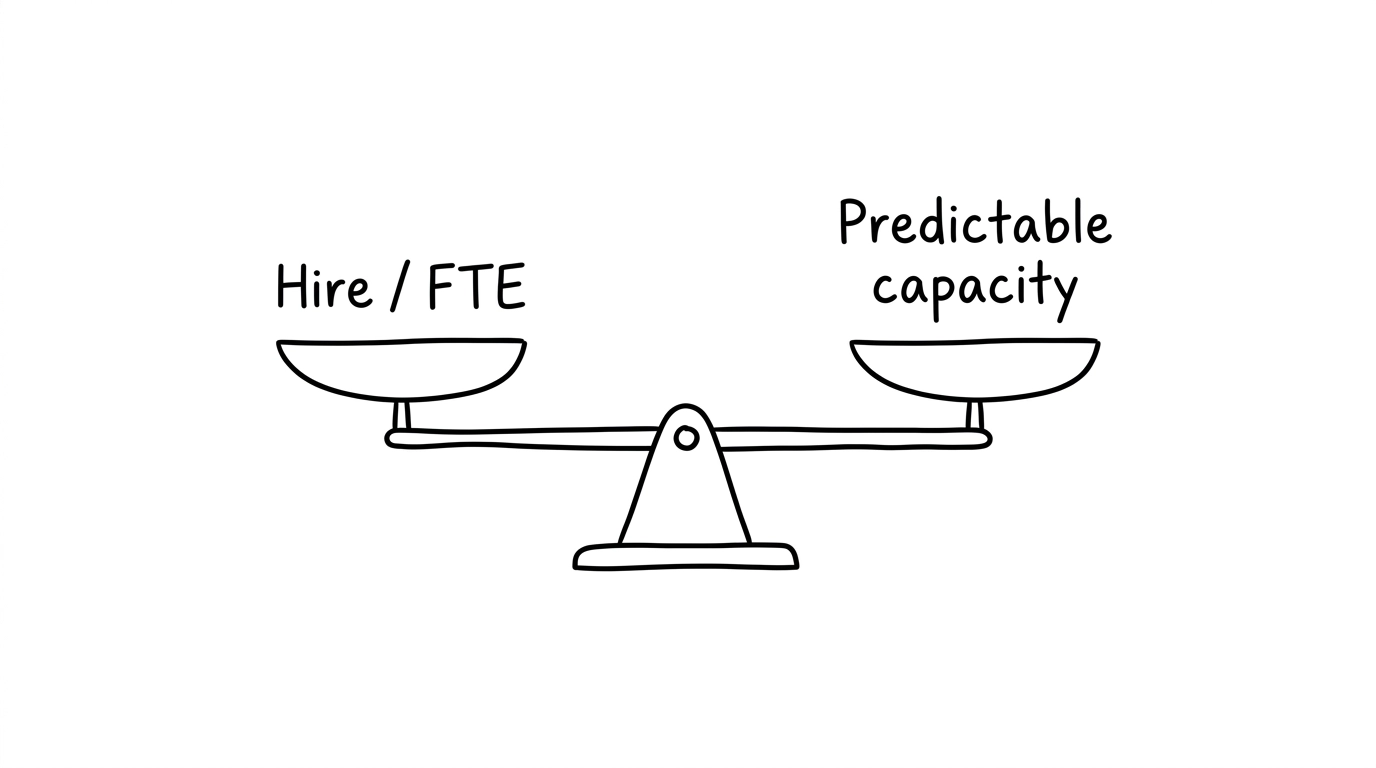 Figure 1: Hiring developers vs buying predictable delivery—time and org constraints, not price alone.
6. Directional self-check
- Does your 12-month demand curve look like a spike or a plateau? Spikes favor external peaks; plateaus favor hire.
- Can you state next-period “done means” within two weeks? If not, fix flow before debating hire vs buy.
- Does finance fear extra FTE or opaque vendor spend more? Each fear suggests different negotiation emphasis.
- Is the team in chronic overtime with slips? That may be methodology debt, not only headcount debt.
7. Closing
In short: hire software developers vs buying predictable engineering capacity is not a moral ranking—it is whether timeline, org absorption, and budget shape match the door you open. Wrong door, tax comes back in another form.
Want to sanity-check HC vs capacity or how to split? Book a 30-minute Discovery Call. Care about flat monthly plans and sprint boundaries? See plans and pricing.
Want to run projects with AI and skip the trial-and-error? Uranus Lab wires multiple tools along requirements → docs → development → retro, with people and AI working together for smooth, fast delivery. Learn more or book a discovery call / get a free quote.
Ready to Build?
Stop building AI wrappers. Build defensible IP with a dedicated engineering pod.