5 Early Warning Signs of Low-Quality Delivery

I. Pitfalls vs. signals
Five Pitfalls When Using AI for Projects focuses on mistakes you make; this piece is about something else: early warning signs you can already see in collaboration before rework and disputes pile up.
Whether you run an in-house team or work with a vendor, the patterns below often mean delivery risk is rising—and they are usually followed by the same costs that never appear on the first quote: rework, communication, alignment, handoff. Learning to spot signals costs less than arguing later over who’s to blame. Each item is written as observable behaviour so you can use it in reviews, weekly syncs, or vendor selection—not to single out any company.
II. Signal 1: Demos without acceptance criteria
What you see: Every check-in can “run” and “show something,” but what counts as done this round stays vague; there are no checkable acceptance items or objective pass / fail standards.
Why it matters: Without acceptance criteria, quality cannot be judged—“finished” becomes a feeling. Next comes an open-ended “one more round”—scope quietly grows while the contract line stays the same.
How it shows up as tax: Hidden rework and scope creep; you thought you bought one delivery, but you keep paying for ambiguity.
III. Signal 2: Plans and ownership stay fuzzy
What you see: Milestones slip often; when you ask “who owns this” or “what’s actually in this release,” the answer is “let’s align again”; scope grows in conversation, rarely in writing.
Why it matters: Solid delivery needs a locked scope and clear ownership. Long-running fuzziness is often missing workable breakdown and sign-off—not “we need more meetings”—and it turns into firefighting.
How it shows up as tax: Communication tax; alignment cost stacks; the same questions keep coming back—that’s the signal flashing.
IV. Signal 3: Key decisions never land in docs
What you see: Important conclusions live in calls or chat; PRDs, design choices, and API agreements don’t match later; new people or new points of contact hear “let me explain again.”
Why it matters: No traceable decision log means you can’t resolve disputes with evidence—collaboration runs on memory and DMs. That’s the enemy of handoff and audit.
How it shows up as tax: Repeated alignment, arguments, rework; much “hidden cost” isn’t hard tech—it’s inconsistent facts.
V. Signal 4: Changes aren’t traceable
What you see: Requirements, interfaces, and priorities move, but there’s no change record or shared version of truth; “what we said last time” doesn’t map to a single line of history.
Why it matters: Engineering delivery iterates on a shared factual base. Untracked changes mean the team can’t tell what extra work happened or where to stop—low-quality output mixes with wasted effort.
How it shows up as tax: Thrash, patchwork fixes, rollback cost; invoices show person-days, not the chaos tax underneath.
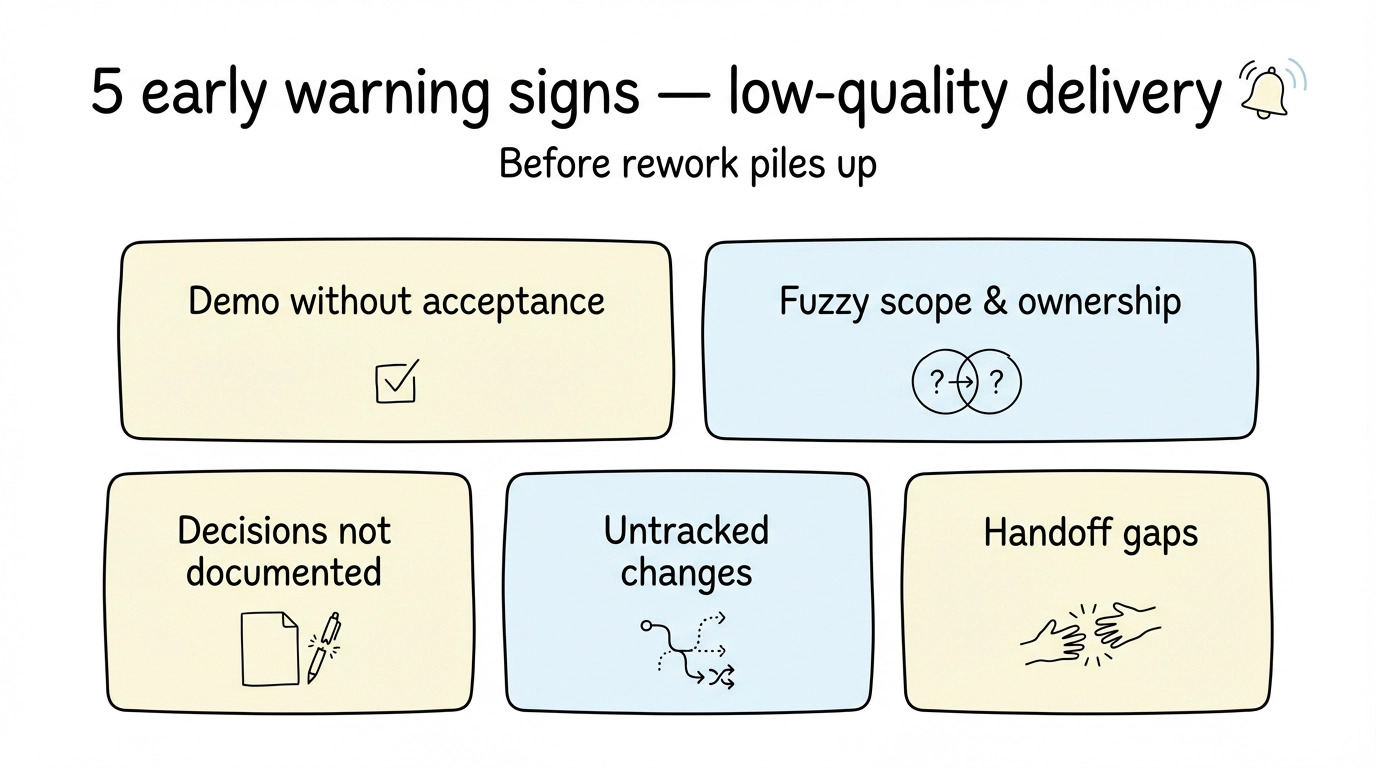 Figure 1: Five observable signals—no acceptance bar, fuzzy boundaries, undocumented decisions, untracked changes, handoff gaps. Spotting them early helps pay less hidden engineering tax.
VI. Signal 5: Handoffs and knowledge gaps (new owner, blank slate)
What you see: Core contacts or leads change often; docs, access, and context aren’t transferred, so every new face starts from zero.
Why it matters: Knowledge lives in heads, not systems—continuity is fragile. This isn’t “people move—that’s normal”; it’s whether the org captures knowledge in how it delivers. If not, it’s a strong sign of low-quality delivery risk.
How it shows up as tax: Handoff tax and take-over cost; this echoes the “knowledge silo” pitfall in the five-pitfalls article, but here the emphasis is what you can observe in how the partnership runs.
VII. Closing
In short: Low-quality delivery usually doesn’t explode overnight—you see signals first: demos without standards, fuzzy scope and ownership, undocumented decisions, untracked changes, and handoff gaps. Treat them as warnings, not blame games, to pay less rework and communication tax later.
Already seeing several of these and want to size the hidden cost in your current setup? Book a free 30-minute call and we’ll walk through it. Want predictable cost, a flat monthly fee, and no surprises? See the plan, pricing, and how sprints work.
Want to run projects with AI and skip the trial-and-error? Uranus Lab wires multiple tools along requirements → docs → development → retro, with people and AI working together for smooth, fast delivery. Learn more or book a discovery call / get a free quote.
Ready to Build?
Stop building AI wrappers. Build defensible IP with a dedicated engineering pod.