Uranus Lab Web3 Delivery: From Requirements to Mainnet

1. Why a Web3 project needs a “how we work” page
When teams look for a Web3 partner, the first questions are usually technical: can you write contracts, build the DApp, and get something to mainnet? Those questions matter, but they only answer “can you build it,” not the more important layer: if we work together, how will this project actually move, where do we align, and how do we manage risk before mainnet?
That is where Web3 projects differ from many standard software projects. The cost of weak security checks is higher, testnet validation matters more, environment and deployment details are easier to get wrong, and handoff problems become more painful once the system is live. In practice, what decides outcomes is rarely just whether someone can write the code. It is whether there is a delivery line from requirements to mainnet that keeps scope, cadence, acceptance, and handoff under control.
If you have already read In Web3 Projects, How Much “Tax” Are You Paying? or 3 Pitfalls in Web3 Outsourcing: Security, Timeline, Handoff, you already know where hidden cost usually comes from. The next practical question is: if you build with Uranus Lab, what does the collaboration actually look like? This piece answers that.
2. How we move from requirements to mainnet
We do not treat a Web3 project as “requirements come in, then we immediately start writing contracts.” A more reliable line is: requirements and scope -> technical specs and docs -> build and integration -> testnet validation -> mainnet release -> handoff and continuity. The underlying logic is the same as The Full AI Project Flow: align first, then build. The difference is that Web3 requires chain choice, environment setup, security checks, and mainnet readiness to become explicit checkpoints much earlier.
The first step is requirements and scope. We define what the product is supposed to do, what chain and environment it targets, how contract responsibility is split, where wallet interactions happen, and what is in or out of scope. A large share of Web3 rework does not come from developers being incapable. It comes from not locking what the contract owns, what the front end covers, and what must be true before mainnet is even discussed.
The second step is technical specs and documentation. This is not paperwork for its own sake. It gives development, testing, and acceptance one shared source of truth. Interfaces, deployment assumptions, testnet plans, dependencies, access rules, and handoff boundaries all need to live here. Otherwise, halfway through the build, teams spend more energy arguing over “which version did we agree on?” than improving the product itself.
The third step is build and integration. Contracts, frontend, wallet connectivity, off-chain logic, and supporting services move against the same scope and spec, not as isolated streams. We prefer exposing issues in stages, rather than letting all risk pile up in the last week before launch.
The fourth step is testnet validation and mainnet preparation. In Web3, testnet is not a symbolic milestone. It is one of the most practical filters before mainnet. Key user flows, failure paths, deployment routines, permissions, and environment details should break here if they are going to break at all. Mainnet should feel like a deliberate checkpoint, not a casual “the code is done, let’s push it.”
The final step is handoff and continuity. For us, delivery is not finished just because the system runs. It is finished when code, docs, deployment notes, permissions, and follow-up context are handoff-ready. Otherwise, the project was completed, but not truly delivered.
3. The Web3 failure points we try to control early
In Web3 projects, the most common failure points are usually security, timeline, acceptance, and handoff. Those words are familiar. The real difference is whether they are managed inside the collaboration model, instead of being mentioned only as general caution.
Start with security. Not every project needs the same level of review or audit depth, but every project should define which parts are highest risk, which checks must happen before mainnet, and which issues are unacceptable to carry into launch. When security is treated as “something we’ll look at near the end,” it often becomes the most expensive rework loop in the project.
Then comes timeline. Many projects do not slip because people type too slowly. They slip because earlier alignment was weak and later stages keep paying for missing decisions. That is why we prefer managing schedule through stage outputs plus checkpoints, rather than through one impressive final date that no one can verify week to week. You should know what is delivered this cycle, what the next approval point is, and which risks are still open.
The third issue is acceptance. In Web3 especially, teams often say “it works” when what they really mean is “some parts now run.” A page loading or a contract deploying does not automatically mean a milestone is done. Acceptance needs to go back to the agreed scope, critical flows, and launch conditions.
The last issue is handoff. Many teams do not fail here because they refuse to hand work over. They fail because handoff was never treated as a first-class deliverable from the start. Durable handoff is not a zip file assembled at the end. It is the result of structured documentation and ownership throughout the build.
4. Working style: sprints, flat monthly fee, predictable rhythm
On the collaboration side, our goal is not to sell you a pile of person-days. It is to make the project move in a rhythm you can actually follow. That is why we prefer organizing work in sprints: each cycle has goals, stage outputs, sync points, and visible risk. You are not forced to wait until the end to discover what is still missing before mainnet.
The pricing model matters too. Web3 projects are especially vulnerable to scope adjustments, environment changes, and coordination overhead. If every shift triggers a fresh pricing conversation, the project slows down under its own commercial friction. For teams that need steady progress and budget visibility, flat monthly fee with clear boundaries is often easier to govern than repeated repricing. The value is not only whether it feels expensive or cheap. The value is that it stabilizes expectations, cadence, and cost.
That is why this piece keeps both positioning lines together. In Web3, less hidden cost and predictable delivery are usually two sides of the same operating model: one explains why projects go off track, and the other explains how they stay under control.
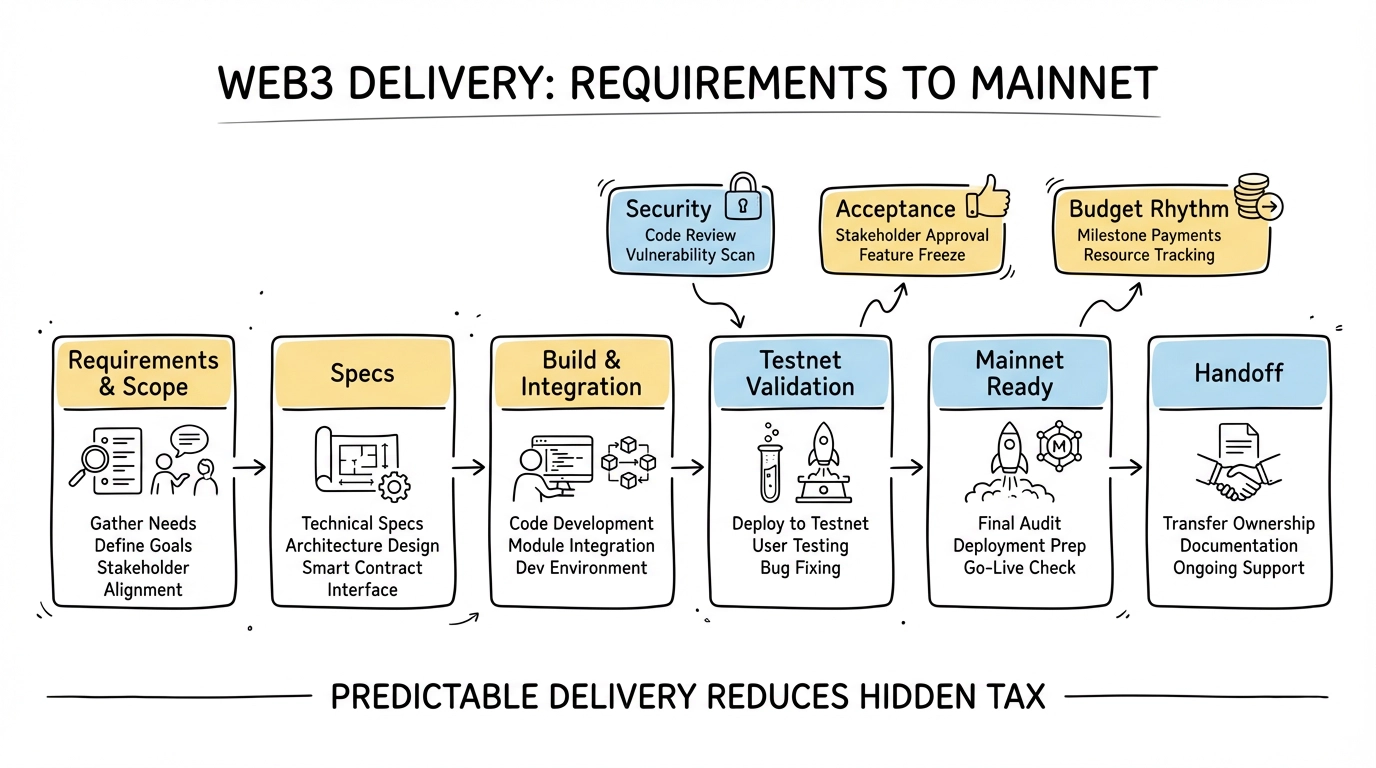 Figure 1: A practical Web3 delivery line from requirements to mainnet, with security, acceptance, release readiness, and handoff treated as checkpoints rather than afterthoughts.
5. Wrap-up
In short: The hard part in Web3 is not only whether someone can write the contract. It is whether requirements, specs, build, testnet, mainnet, and handoff can be turned into one controllable delivery line. Clear stages, clear checkpoints, and clear rhythm are what keep hidden cost down.
If you are preparing a Web3 project and want to discuss your current plan, risk profile, or collaboration model, book a discovery call. If your main concern is budget visibility, sprint rhythm, and whether flat monthly fee fits the project, you can start from the plan and pricing page.
Want to run projects with AI and skip the trial-and-error? Uranus Lab wires multiple tools along requirements -> docs -> development -> retro, with people and AI working together for smooth, fast delivery. We do AI projects and Web3 projects with the same promise: less hidden cost, flat monthly fee, predictable delivery. Learn more or book a discovery call / get a free quote.
Ready to Build?
Stop building AI wrappers. Build defensible IP with a dedicated engineering pod.